
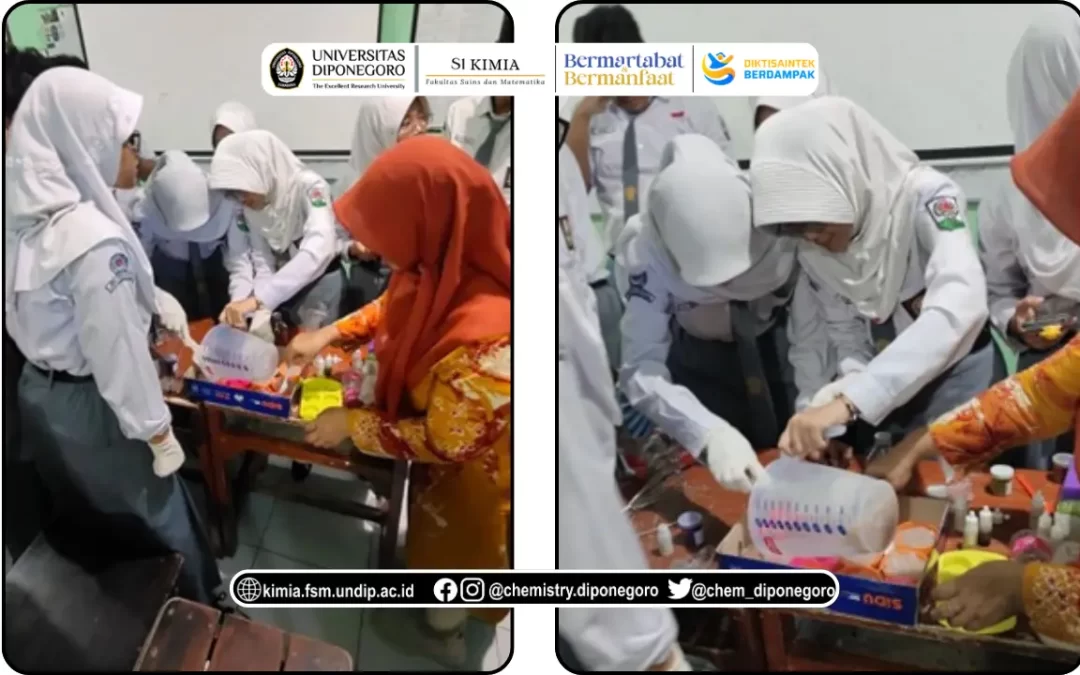
Semarang, October 14, 2025 — A community service team from the Department of Chemistry, Faculty of Science and Mathematics, Diponegoro University, held an environmental education program titled “Utilizing Organic Waste as a Basic Ingredient for Eco-enzyme Soap Production” at SMA Kesatrian 2 Semarang. The activity aimed to raise students’ awareness about managing organic waste and to promote the application of environmentally friendly innovations within the school environment.
The community service program was led by Damar Nurwahyu Bima, M.Si, with team members Dr. Suhartana, M.Si, Dra. Sriyanti, M.Si, Dr. Mukhammad Asy’ari, M.Si, Pardoyo, M.Si, and supported by several Chemistry students from UNDIP.
During the activity, the team delivered a presentation on the issue of organic waste, which remains a challenge in many regions. Through simple and practical scientific approaches, students were introduced to the concept of eco-enzyme—the fermented liquid derived from organic waste that can be used as a natural cleaning agent and as a basic ingredient for soap.
Twelfth-grade students participated in hands-on practice to produce eco-enzyme–based soap using safe and easily accessible household materials. They learned to process organic waste—such as fruit and vegetable peels—through fermentation stages to produce eco-enzyme liquid that is environmentally friendly.
The head of the community service team, Damar Nurwahyu Bima, explained that the activity not only targeted knowledge but also aimed to foster practical skills and environmental awareness from an early age. “We hope that students can understand that organic waste has significant value when managed properly. Products like eco-enzyme soap can serve as a real example of recycling and circular economy concepts,” he said.
The program also opens opportunities for students to develop entrepreneurship based on eco-friendly products. With the skill of producing eco-enzyme soap, students can explore creativity in generating economically valuable products while supporting environmental sustainability.
SMA Kesatrian 2 Semarang welcomed this activity and hopes for continued collaboration with UNDIP in future science and environmental education initiatives. This community service activity is part of the routine program of the Chemistry Department, FSM UNDIP, which is committed to making tangible contributions to society through the application of science and technology.