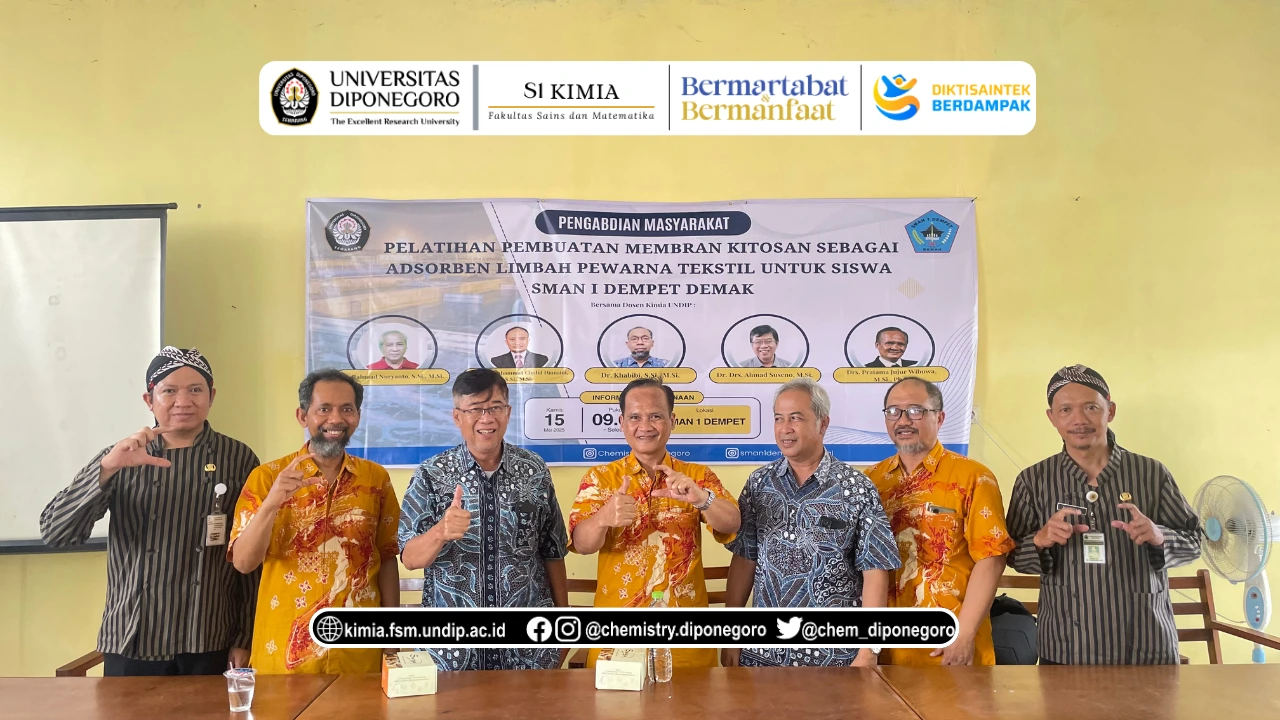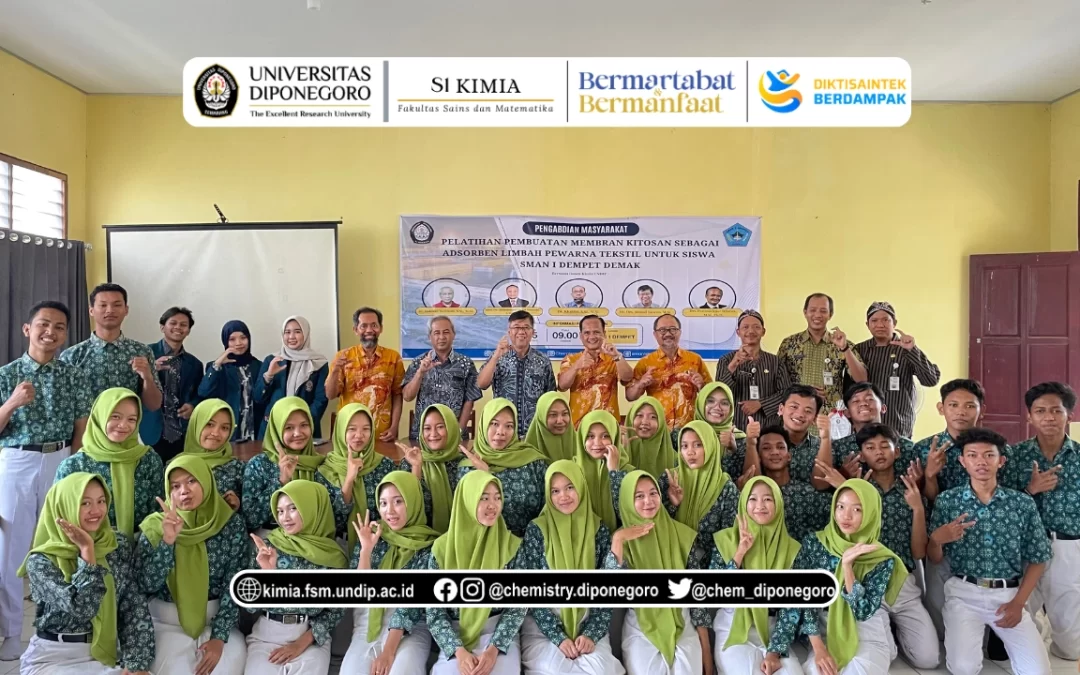
At SMAN 1 Dempet, Demak, the chemistry laboratory transformed into a lively “mini research lab.” The Community Service Team from the Department of Chemistry, Faculty of Science and Mathematics, Universitas Diponegoro (UNDIP), came with a highly relevant mission: encouraging students to develop practical solutions to the problem of textile dye waste that often contaminates water in areas surrounding industrial centers. The activity was conducted on 15 May 2025, focusing on hands-on training in the preparation of chitosan membranes—a material derived from shrimp shell waste—that can function as an adsorbent for dye pollutants.
Context and Scientific Background
The issue discussed is closely related to students’ daily lives. Synthetic dye waste from the textile industry is difficult to degrade naturally and can be harmful to the environment. One example is methylene blue, a dye commonly used in fabric coloring. During the theory session, students learned why such dyes need to be properly treated and why chitosan is an attractive material: it contains active functional groups capable of binding dye molecules, enabling contaminated water to be partially restored through an adsorption process.
Practical Activities
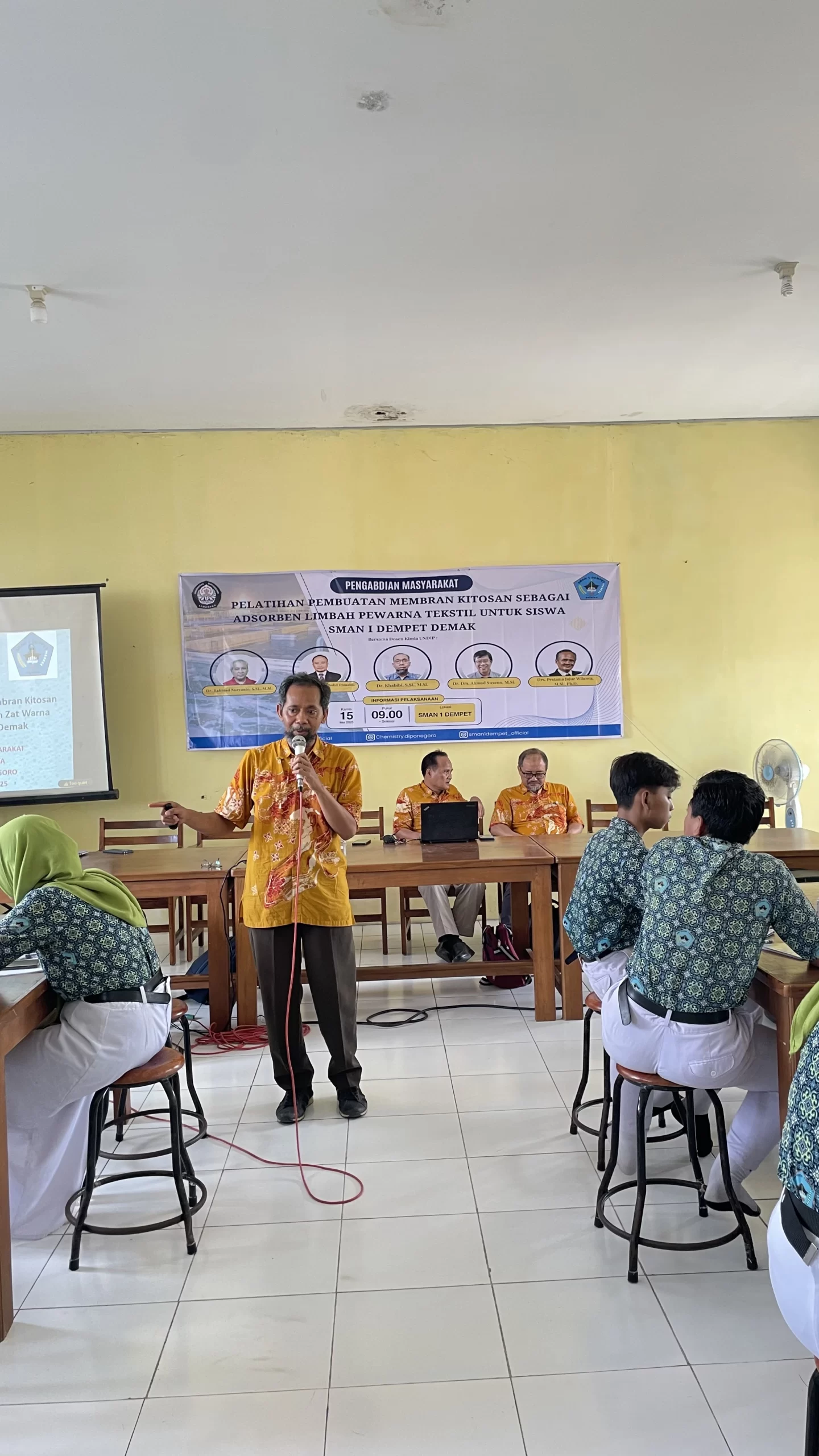
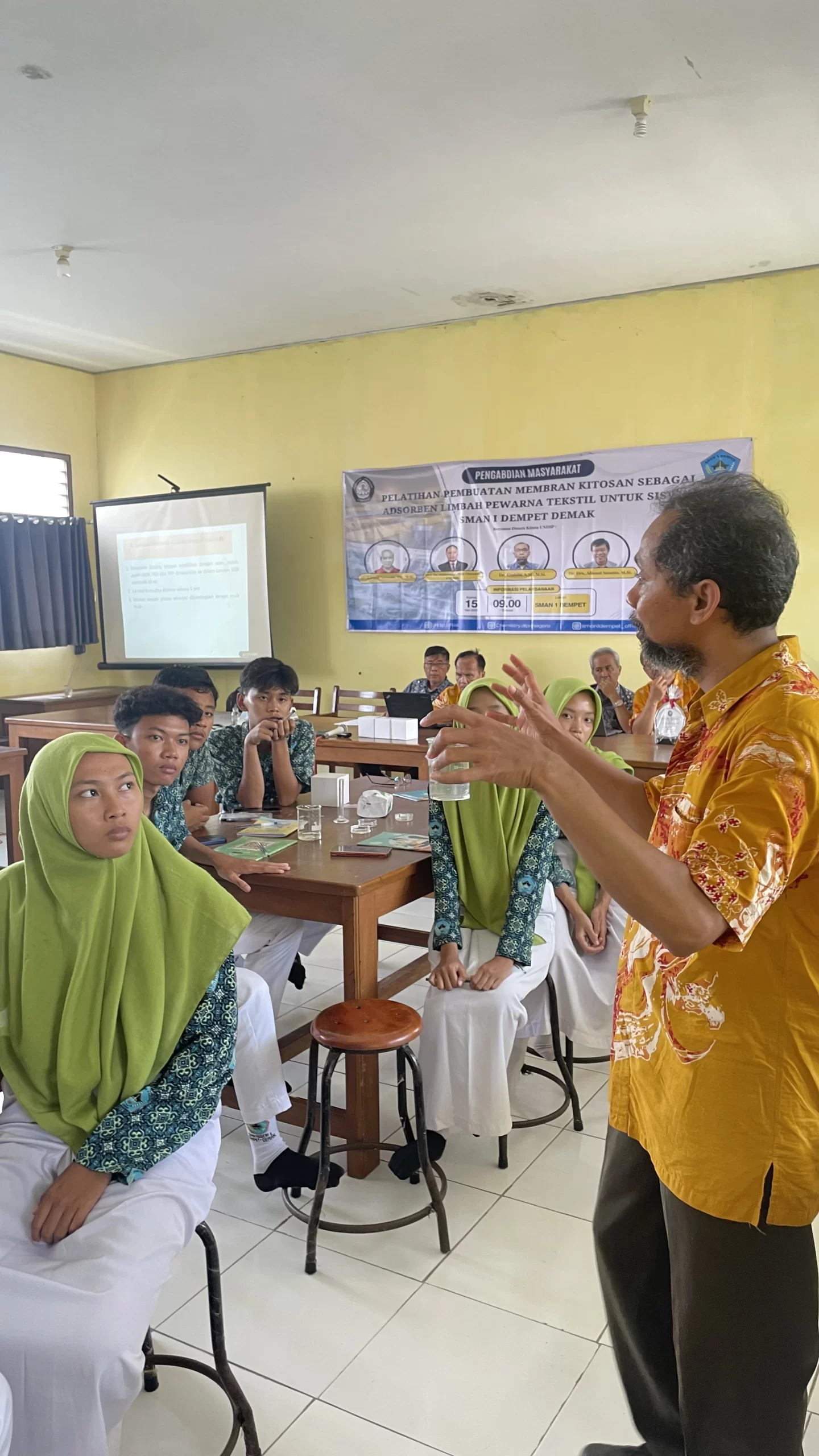
The most anticipated part was the laboratory practice. Approximately 30 students took part in a full learning sequence—from theory and demonstrations to direct hands-on experiments. The practicum included dissolving chitosan in acetic acid, casting it into thin membranes, and testing the membranes in methylene blue solutions.
Students were also introduced to membrane modification techniques, such as the use of crosslinking agents (e.g., PVA/TPP), to observe how material properties can be enhanced or “upgraded.” The outputs of the activity were not limited to experience alone, but also tangible products in the form of chitosan membranes and a simple learning module that can be reused in future activities.
Evaluation and Impact
To assess learning outcomes, pre-tests and post-tests were conducted. The results showed a clear improvement in students’ understanding after the training, with around one-third of participants achieving perfect scores on the post-test.
One of the most satisfying moments occurred when students observed the visible difference in the methylene blue solution before and after adsorption. This instant visual evidence reinforced the idea that their experiment was not merely a school assignment, but a small step toward developing environmentally friendly technology with real impact.
This second community service activity at SMAN 1 Dempet, Demak, received positive appreciation, especially since the first program had successfully motivated students from the school to be accepted into the Chemistry Department of Universitas Diponegoro.